
Home layout and access
Open basement ceilings and straight chases reduce labor. Finished ceilings, tight joist bays, and multiple floors usually increase time and patch coordination.
Serving Calgary, Alberta & surrounding areas
24/7 Emergency Response
If your home still has poly-b piping, we'll help you confirm what's installed, map a replacement scope, and understand the real costs and pipe options before work starts.
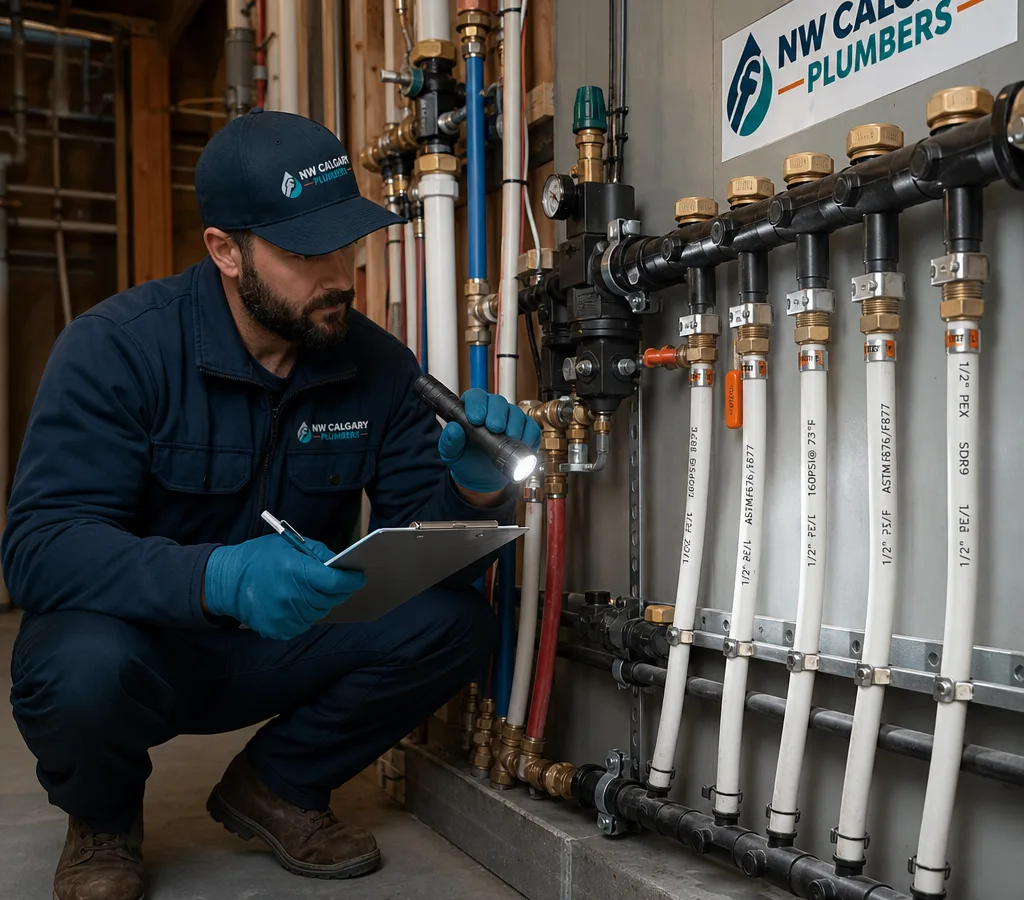
If you searched poly b guys Calgary, you're likely trying to answer three practical questions: Do I actually have poly-b plumbing, what will it cost to replace, and what pipe should go in next?
Poly-b (polybutylene) piping is commonly found in Canadian homes from the late 1970s through the 1990s. In Calgary, that often lines up with many family homes built during big growth years. The decision to replace is usually driven by risk tolerance, future plans—such as selling, renovating, or refinancing—and how accessible the piping is.
At NW Calgary Plumbers, our job is to make the replacement plan clear: what is being replaced, where we'll run new lines, how we'll protect finishes, and what the schedule looks like. We can also help with general plumbing in Calgary, Alberta, but this service is specifically about poly-b identification and poly b pipe replacement in Calgary.
A proper poly-b assessment is quick, but it needs to be methodical. We look for where the water service enters, trace distribution lines to bathrooms, kitchen, laundry, and any basement wet bar, then check visible runs at the water heater and around shutoffs.
What we document:
In Calgary homes, a common pattern is a mechanical room and main trunk in the basement with runs up to second-floor bathrooms. That vertical routing is the difference between a clean repipe and a project that needs more opening and patching. We'll explain what needs to be opened, if anything, and what can usually be left untouched.
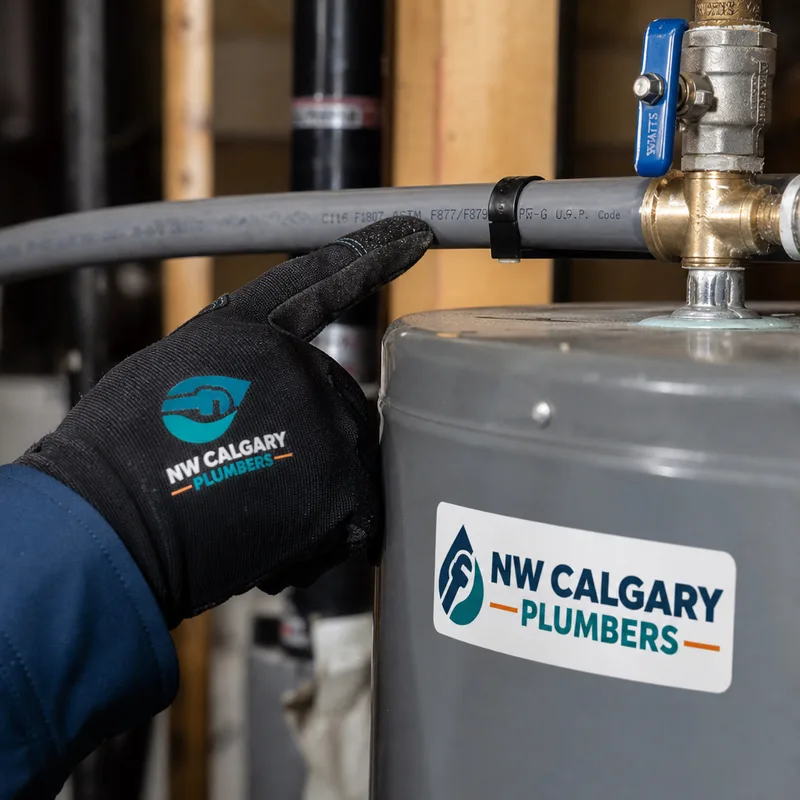
Poly b replacement Calgary cost typically ranges from about $4,000 to $15,000+ for a full-home repipe, depending on house size, number of bathrooms, and access. Smaller bungalows with open basements often land toward the lower end, while two-storey homes with finished ceilings and multiple bathrooms trend higher.
Your final cost changes with pipe choice—PEX versus copper—how many fixtures are tied in, how many shutoffs and manifolds are needed, and how much opening and patch coordination is required. We confirm the exact scope and price after an on-site inspection of your poly-b plumbing and access points.
Open basement ceilings and straight chases reduce labor. Finished ceilings, tight joist bays, and multiple floors usually increase time and patch coordination.
Every tub or shower, vanity, toilet, kitchen sink, laundry, and hose bib adds tie-ins, shutoffs, and testing time. More fixtures means more lines and connections.
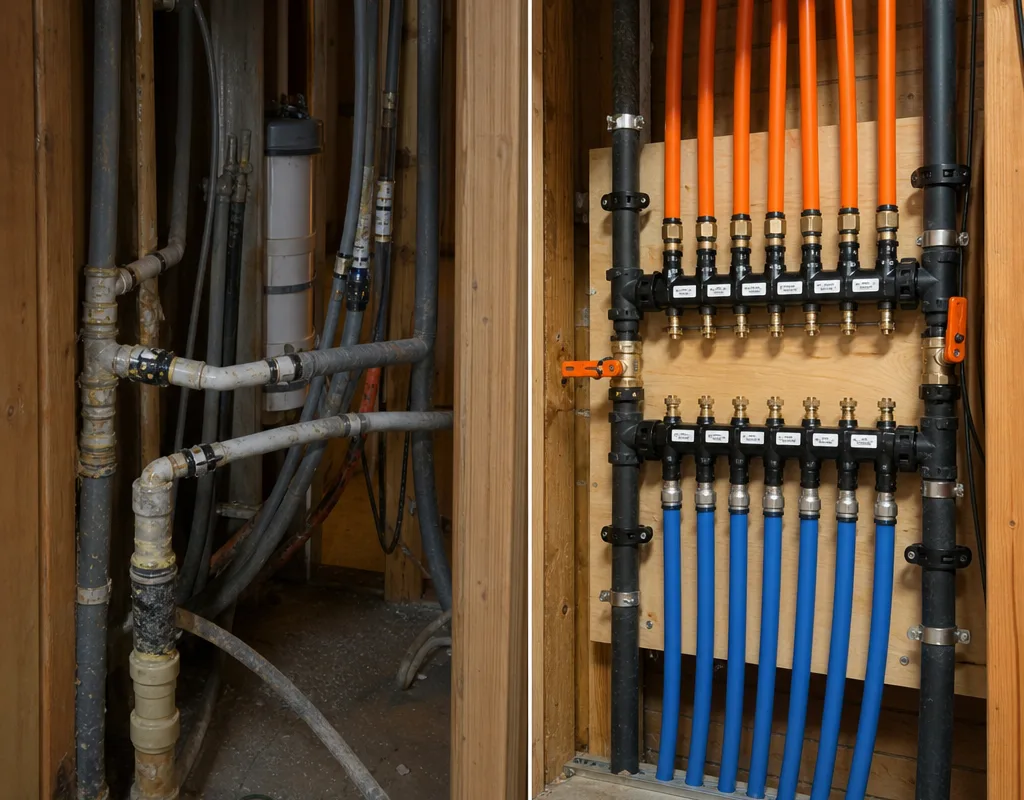
PEX is common for repipes because it routes easily through framing and supports manifold layouts. Copper can be selected for specific preferences, but routing and labor can be different.
A manifold can simplify future shutoffs and balance runs, but it requires space and thoughtful placement. Branch systems can be fine, but may take more time to route cleanly.
Replacing poly-b often includes reworking the immediate piping at the water heater and main shutoff area so everything is consistent, supported, and code-compliant.
Partial replacements can lower upfront cost, but they leave poly-b in place. We'll walk you through what remains, where transitions are, and how that affects your risk.
Most homeowners want a simple answer: what pipe should replace poly-b plumbing in Calgary? The practical choice is usually PEX, and the reason is routing and serviceability.
We'll recommend the material based on access, layout, and your priorities. If you are comparing options, ask for the pros and cons in your exact house rather than a generic rule. The same material can be a great fit in one property and a pain in another.
If your replacement is timed around a renovation, we can coordinate the plumbing scope so walls are opened once and the new lines land where your fixtures will actually be.
We confirm where poly-b is present, identify transitions, and map the routes to each fixture. You get a clear scope: full repipe or defined partial replacement, with what is included.
We choose a branch or manifold layout, set shutoff locations, and plan the cleanest runs through joists and chases to limit openings in finished areas.
We isolate the system, protect work areas, remove and cap poly-b as required, then run new lines and connect fixtures with proper supports and labeling where applicable.
We pressure test the new system, verify each fixture, check for leaks, and review shutoff locations with you so you know how to isolate a bathroom or a single fixture later.
If any access openings are needed, we'll document what was opened and where, so drywall repair and paint are straightforward and you avoid guesswork.
“We had poly-b throughout the house and wanted a straight answer on what it would take to replace it. The quote matched the scope they explained, and the new shutoffs and layout make future work a lot easier.”
“They walked us through PEX vs copper without pushing one option. The routing plan made sense for our finished basement, and the water was only off for a manageable window.”
Full replacement is the most complete way to remove poly-b risk, but partial replacement can be appropriate when poly-b is limited to a specific area or when access is constrained. The key is to be explicit about what remains, where transitions will be, and how shutoffs and future service will work with mixed materials.
Most repipes take 1 to 3 days of on-site plumbing work, with the timeline driven by house size, number of bathrooms, and how much ceiling or wall access is available. We'll also tell you what water shutoff windows to expect so you can plan around work, school, and pets.
A typical quote includes removal or abandonment of accessible poly-b, installation of new supply lines to fixtures, new shutoffs where appropriate, connections at the mechanical room distribution area, pressure testing, and commissioning. Items that can be separate are drywall repair and paint, plus any fixture upgrades you choose to do at the same time.
PEX is often preferred for repipes because it routes through framing with fewer openings and fewer hidden joints, while copper can be a good choice when you want rigid pipe throughout or the routing is straightforward. We'll recommend the best fit based on access, your layout, and whether a manifold system makes sense in your mechanical room.
Sometimes, but not always. Open basements, utility chases, and accessible joist bays can allow a clean repipe with minimal openings, while developed basements and finished ceilings can require strategic access points. During the inspection we'll identify likely opening locations before any work starts.
Yes, finished basements are common and replacement is still possible, but routing takes more planning. We look for existing bulkheads, mechanical room access, and vertical chases to minimize disruption, and we'll be clear about any areas that may need small access openings for safe tie-ins and testing.
Tell us what type of home you have and what you know about the piping so far. We'll confirm whether it's poly-b, explain the best replacement approach, and provide a written plan for your Calgary repipe.